7: Long-term care today: Kaigo Hoken
Japan's mandatory long-term care insurance program

In April 2000, the Long-Term Care Insurance Law (Kaigo Hoken, 介護保険法) was enacted. This is a nationwide, mandatory social insurance system which covers long-term care for those 65+ and certain disabled individuals aged 40–64 with age-related illnesses, such as stroke, Parkinson’s, and dementia. It’s funded by municipal insurance premiums for those over the age of 40, user fees (generally 10-20% of costs), and government subsidies (national and local).
A care manager assesses each person’s needs and classifies their level of care and support needs. There are 5 levels of care and 2 levels of support. A personalized care plan is then prepared. The goal is to avoid institutionalization whenever possible. Institutionalization is now one option among many, rather than the default. Many residential facilities now serve as short-term respite centers or specialized care homes.
The care plan might include:
In-home care (nursing, bathing, meal assistance)
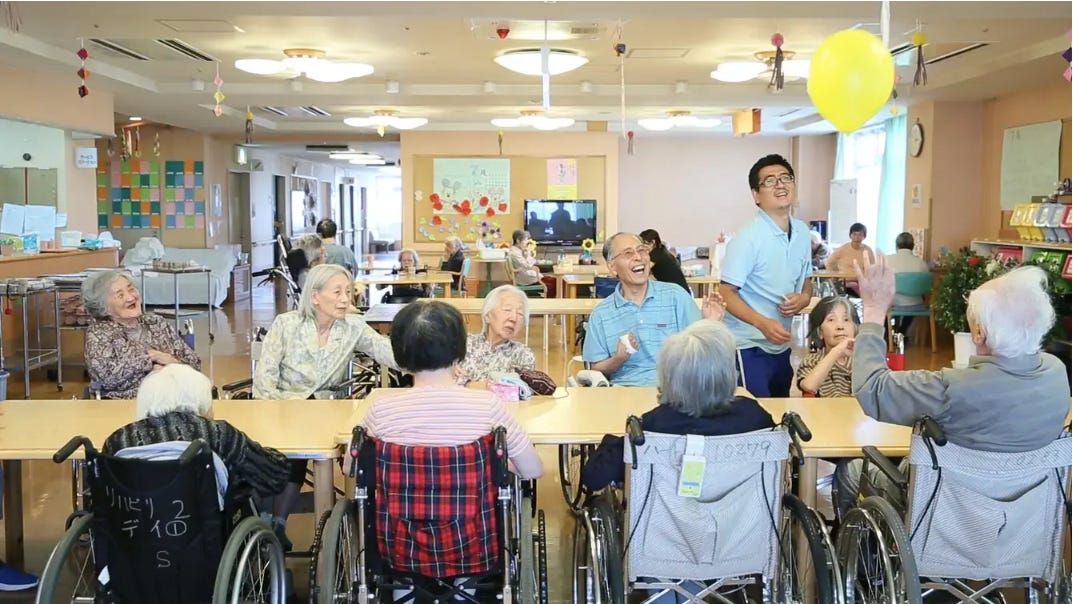
Daycare services
Short-term institutional care (respite care)
Rehabilitation and assistive devices
The municipality coordinates care and acts as the insurer. Care can be provided by private companies, government employees, or nonprofits. The actual services provided are standardized, regardless of the entity providing care. The fee schedule is set by the national government. Municipalities are required to provide a set of standard services, if a provider is available, and are free to provide additional community support projects.
Since the municipality coordinates care and organizations provide hands-on services, the role of the family is shifted to emotional and social support.
If you’re thinking this sounds a lot like long-term care provision in Sweden, you’re right. In Sweden:
Sweden’s program is universal, rather than being based on age and age-related illnesses.
Their program is funded through municipal taxes (rather than municipal insurance premiums), user fees (adjusted for income), and government subsidies.
Both programs are standardized nationally.
Municipalities are legally responsible for providing long-term care to all residents, similar to Japan’s municipal insurers.
They both provide home care, day centers, outpatient rehabilitation, and community integration.
In Sweden, municipalities can adjust eligibility requirements to reduce costs, while in Japan required services can be cut if they can prove there are no available local providers.
Care providers are more likely to be government employees in Sweden, although they also use private and nonprofit providers.
Municipalities are free to add additional services.
Recipients of long-term care in Sweden are much more likely to live alone than in Japan.
The biggest difference is that most people in Sweden had access to subsidized long-term care support at home since the 1970s. When developing Kaigo Hoken, Japan studied European models of long-term care provision, particularly Sweden, Denmark, and the Netherlands. Japan copied Germany’s 1995 Long-Term Care Insurance model in order to fund the system. Sweden’s system is financed by taxes, not insurance premiums.
Other Scandinavian countries share similarities, but Sweden’s system is the most formalized, standardized, and decentralized, meaning it’s the most similar to Kaigo Hoken.
Japan, along with Spain and Italy, is famous for having rural villages that consist of a handful of elderly residents, with all of the younger people having left for the cities. This makes me wonder how a municipal program can work, although if the insurance premium is only paid by people old enough to qualify, I suppose the number of people under 40 is irrelevant. More importantly, there is a national redistribution system, so wealthier municipalities subsidize ones whose systems would collapse if they were self funded.
In a way, it’s a return to the traditional provision of care at the local level through goningumi, kō, and temples. Now, however, there is a formal program specifically to provide support to people who need long-term care, rather than support provided as a consequence of collective responsibility for upholding conformity.
The Meiji period has still left its mark. The Yōikuin (養育院), built in Tokyo in 1872, was one of the Meiji government’s first major social welfare institutions. It was the public face of the state’s move away from temple-based and hinin-led charity toward a formal, Western-inspired institutional system. It opened as a poorhouse. This was rebranded as charity care for the elderly, the disabled, and children. Today it’s the Tokyo Metropolitan Geriatric Hospital and Institute of Gerontology.